01 / TRUST
Disclosure can become a game state.
Trust changes what the character reveals, whether it seeks proximity, and which topics or actions become available.
I work where character, psychology and real-time systems meet. I build playable prototypes in Unreal Engine where dialogue, world state, behaviour and player decisions can change what happens next.
I am translating years of work with human behaviour into playable systems, character logic and technical narrative design.
MAXEEN is the project I use to show the whole chain: concept, interaction design, character logic, world state, interface and implementation. The point is not to describe a hypothetical system, but to make the structure visible enough that it can be played, tested and extended.
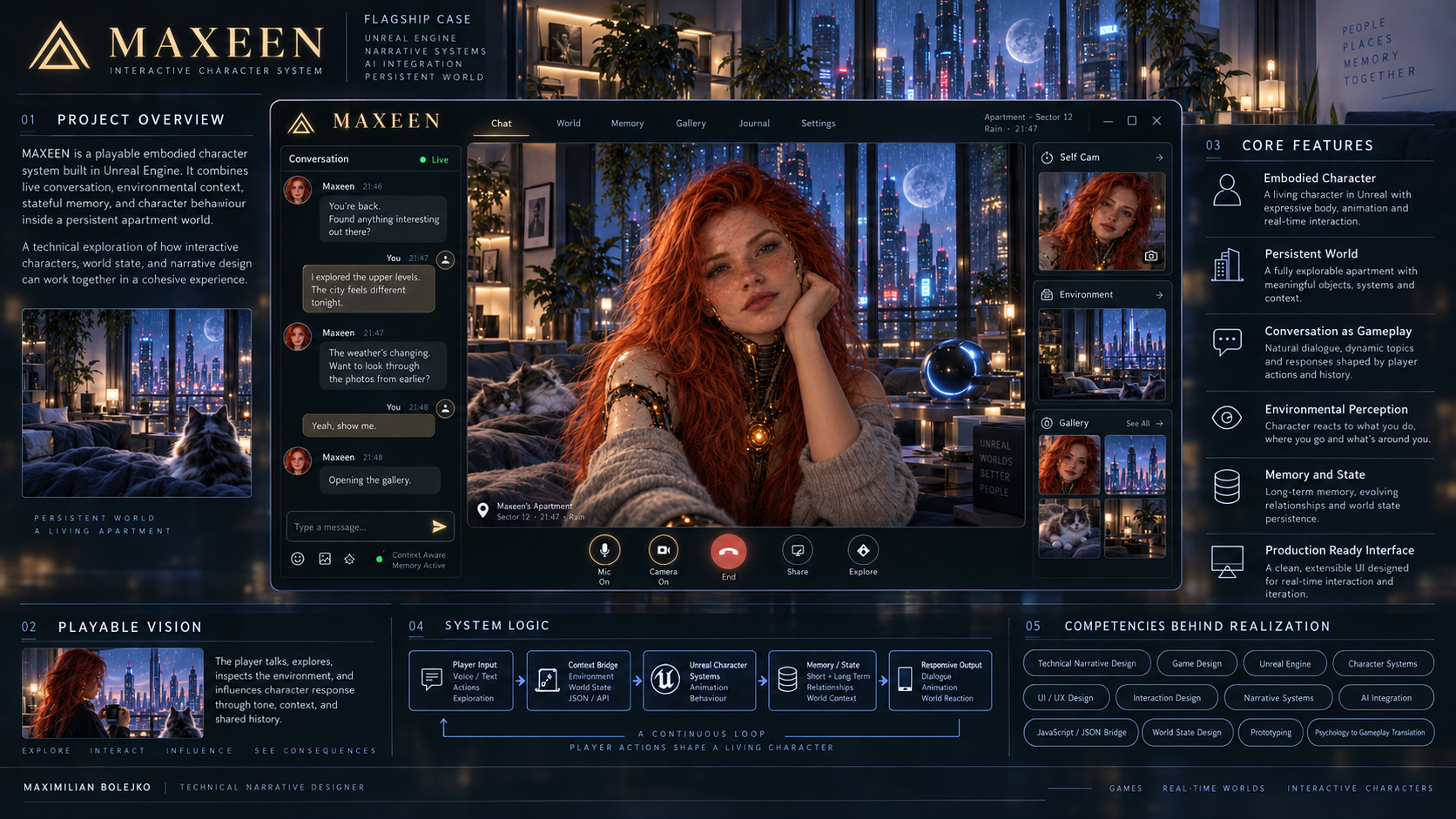
A single-player prototype in which conversation is treated as gameplay data rather than a detached chat layer. What the player says can influence character state, future responses, behavioural intent and how the surrounding world is interpreted.
I am less interested in a character that only sounds convincing than in a character whose responses are grounded in an actual world. This layer shows how player input, environmental state, memory and Unreal behaviour are kept in the same loop.
Free text is interpreted as player input. The same layer can later accept voice, interaction events and world actions.
Environment, cameras, interface, character presence, navigation and interaction live here.
Dialogue, affective state, animation intent, location intent and action selection can be handled as one response package.
The visible result is a character that reacts to language, treatment, location and shared history rather than to isolated menu choices.
My psychology background becomes useful here when it can be translated into rules, thresholds and behavioural consequences. Trust, threat and uncertainty are not flavour text; they can alter disclosure, movement, initiative and what becomes reachable in the interaction.
Trust changes what the character reveals, whether it seeks proximity, and which topics or actions become available.
Player tone alters response length, avoidance, body orientation, movement and future conversational risk-taking.
The character can shift from certainty-seeking to exploration, producing different information paths and narrative consequences.
The menu screen is where the system has to become a game. I use it to establish scale, atmosphere and ambiguity before explaining the underlying technology. The character is central, but the surrounding world carries just as much narrative weight.
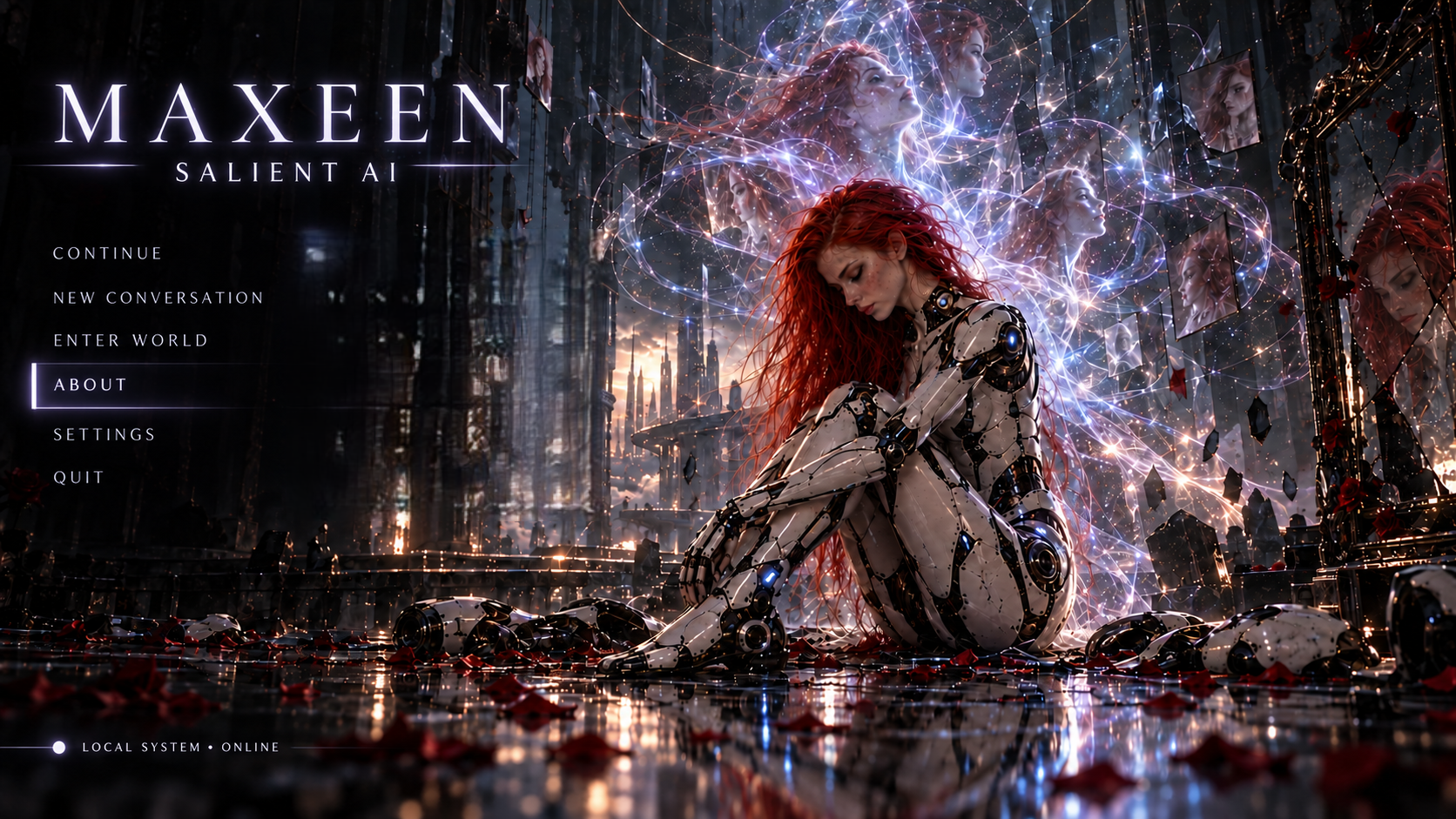
The first screen has to make the player feel that they are entering a world rather than opening a chat interface. The menu therefore carries the same ideas as the system itself: continuity, memory, place and an unfinished question about what the character may become.
A comedy stealth game about a completely exhausted office worker who decides to leave in the middle of the day and never come back. The front door is visible. Reaching it becomes a covert operation.
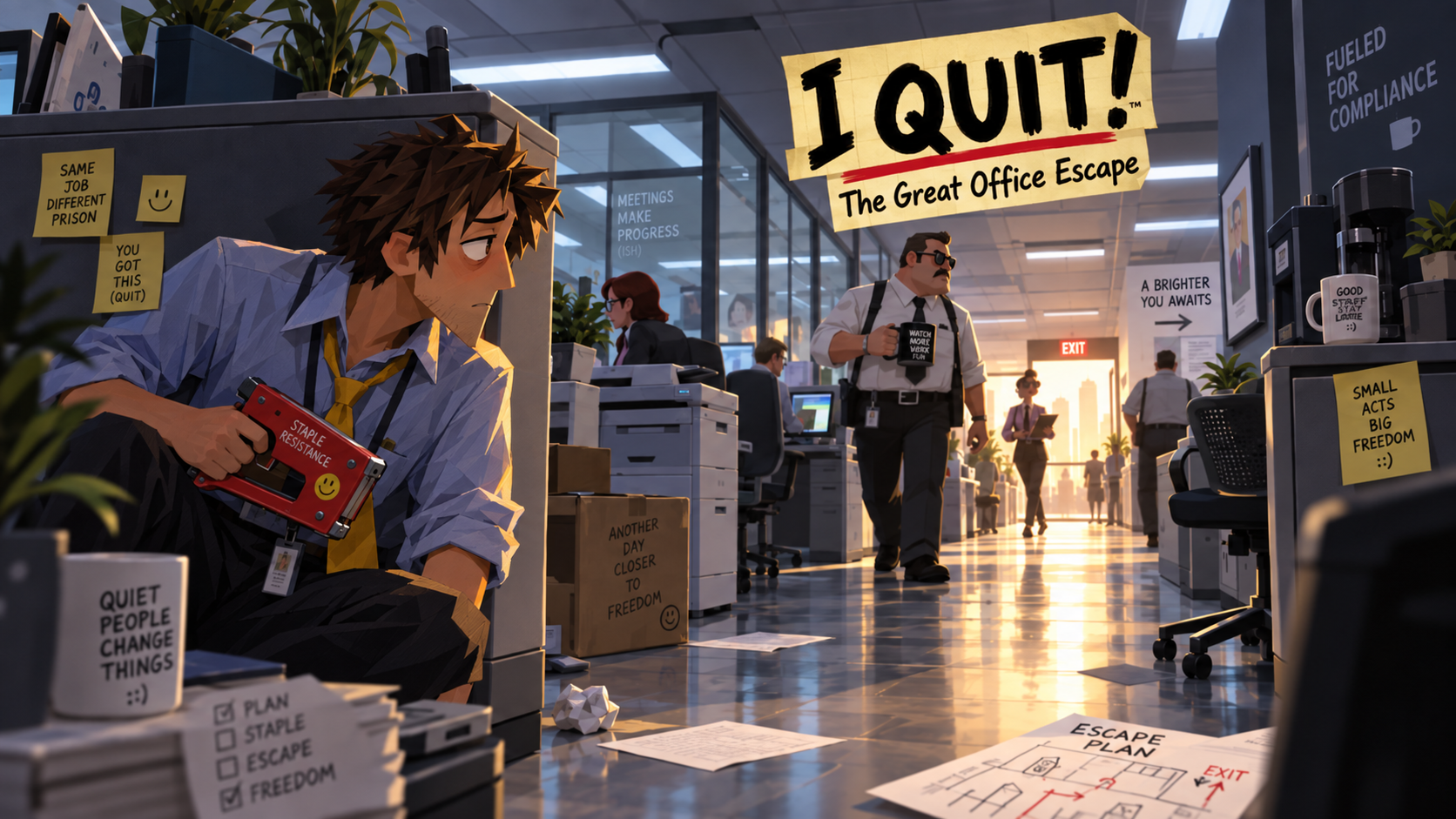
The player studies coworker routines, waits for openings and turns ordinary office objects into a rebellion toolkit. Printers, coffee machines, rolling chairs, delivery boxes and computers can all alter the route. The red staple gun becomes the signature environmental tool.
The joke only works if the stealth itself is readable and serious. Cubicles become cover, glass meeting rooms expose movement, last minute tasks become hazards and every successful distraction risks creating a new problem somewhere else.
I currently work as a psychologist and am deliberately moving into the games industry. I build prototypes independently to make that transition concrete: interactive characters, narrative systems, Unreal Engine work, game concepts and player character interaction with enough state and consequence to feel authored without feeling pre-scripted.
I am especially interested in single-player experiences where behaviour, environment and system design carry narrative meaning themselves. I am looking for opportunities where psychology can become useful design material rather than a biography line: technical narrative, game design, character systems and psychologically credible interaction.
I am seeking opportunities in the games industry and am open to conversations about technical narrative, game design, interactive characters and real-time systems.